

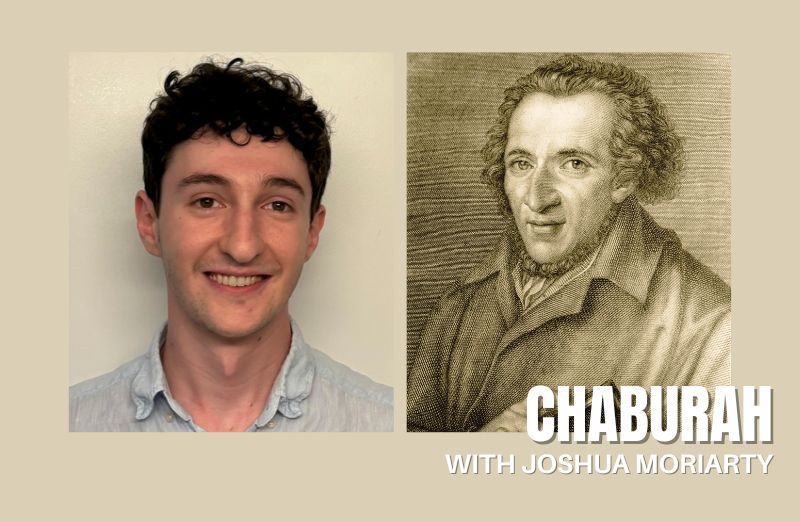
Post-Kiddush Chaburah Learning with Josh Moriarty
“The Disputation That Wasn’t: Moses Mendelssohn’s Defense of Judaism in the German Enlightenment”
Moses Mendelssohn (1729-1786) was a singular figure in 18th-century Germany. At a time when Jews were largely excluded from universities, he was a mostly self-taught prodigy who became one of the most prominent philosophers of the German Enlightenment. For many, he was the only visible Jew in “enlightened” intellectual circles. Because of this unique position, he was often held up as an example by defenders of religious toleration—living proof that Jews, too, were capable of wisdom and virtue. But he also posed a problem for many Germans: they assumed that the “enlightenment” of Jews would inevitably lead to their conversion to Christianity, yet the unquestionably “enlightened” Mendelssohn didn’t convert.
In 1769, a pastor publicly challenged Mendelssohn to either refute Christianity philosophically or convert to it. This learning will focus on Mendelssohn’s response, a refusal to engage in the proposed disputation. Through a close reading of Mendelssohn’s brilliant letter, we will learn about the position of Jews and Judaism in the German Enlightenment; the connections between philosophy, religion, and politics in this period; and how to read authors who wrote in contexts of persecution and censorship.